
Monday, July 8, 2013
Jan Henryk de Rosen
I have been granted permission to curate an exhibition from the Ravenna Mosaic archives at Saint Louis University's Pius XII Memorial Library on celebrated Polish muralist, exile, and war veteran, Jan Henryk de Rosen. Jan Henryk de Rosen designed the main dome at the Cathedral Basilica of Saint Louis -- it is often hailed as the largest mosaic in the world. More info to come soon.


Against All Odds: Polish Graphic Design 1919-1949, Piotr Rypson. Karakter Press
Against All Odds: Polish Graphic Design 1919-1949, Piotr Rypson. Karakter Press, 2011
Jarek Czernikiewicz obtained a copy of this book for me. It is a really thorough and amazing volume on interwar Polish graphic design. I am working on bringing this author to SLU's International Studies Department for a lecture in association with Saint Louis Polonia.
Please read more here: http://www.printmag.com/design-inspiration/polish-graphic-design-illustrated/


Thursday, June 20, 2013

Joanna Zastróżna (1972 - Current)
Joanna Zastróżna (1972 - Current)
Studied at the Academy of Fine Arts in Gdańsk, graduating in 1997
Her photography mainly consists of negatives that have been drawn on and colored in a distinct colorful fashion that often involves images of humans and/or animals suggesting injury, perversion, and trespass. Bodily fluids, nudity, bandages and other medical equipment often appear in her experimental work which is influenced by and reminiscent of radiographs and X-rays.
Her website: www.zastrozna.asia


Studied at the Academy of Fine Arts in Gdańsk, graduating in 1997
Her photography mainly consists of negatives that have been drawn on and colored in a distinct colorful fashion that often involves images of humans and/or animals suggesting injury, perversion, and trespass. Bodily fluids, nudity, bandages and other medical equipment often appear in her experimental work which is influenced by and reminiscent of radiographs and X-rays.
Her website: www.zastrozna.asia


Greatest hits from the Polona digital library
The National Library’s Digital Polona collection:
http://www.culture.pl/web/english/resources-literature-full-page/-/eo_event_asset_publisher/eAN5/content/greatest-hits-from-the-polona-digital-library
http://www.culture.pl/web/english/resources-literature-full-page/-/eo_event_asset_publisher/eAN5/content/greatest-hits-from-the-polona-digital-library
Tuesday, June 4, 2013
Marta Deskur (1962 - Current)
Marta Deskur (1962 - Current)
Studied at the Academy of Fine Arts, Krakow.
Studied at École des Beaux-Arts in Aix-en-Provence, France.
Marta Deskur's light box installations capture tension and straining force through composition and through positive vs. negative values. Almost all these works have a unique omission, this omission suggests a metaphysics only implied or suggested, certainly not tangible. More information on her work here: http://www.culture.pl/web/english/resources-visual-arts-full-page/-/eo_event_asset_publisher/eAN5/content/marta-deskur


Studied at the Academy of Fine Arts, Krakow.
Studied at École des Beaux-Arts in Aix-en-Provence, France.
Marta Deskur's light box installations capture tension and straining force through composition and through positive vs. negative values. Almost all these works have a unique omission, this omission suggests a metaphysics only implied or suggested, certainly not tangible. More information on her work here: http://www.culture.pl/web/english/resources-visual-arts-full-page/-/eo_event_asset_publisher/eAN5/content/marta-deskur


Monday, June 3, 2013
Władysław Hasior (1928 - 1999)
Władysław Hasior (1928 - 1999)


Studied under Professor Antoni Kenar at the
State Secondary School of Visual Art Techniques in Zakopane.
Studied under Marian Wnuk in sculpture at the Academy of Fine Arts in Warsaw.
Studied under Ossip Zadkine in Paris.
Hasior
may be my favorite artist of all time. How could I not love an artist who sets
the majority of his public works on fire at the opening? In Zakopane I had the honor of visiting both
his grave and his studio-turned-gallery as well as the Hasoir collection at the National Museum in Wroclaw and Krakow, Poland. A local Zakopane girl said it best when she
described his work as "devastating." In my opinion his sculptural works are surreal abstractions of the Podhale region's folk art, but certainly still devastating on many levels. I could go on and on about the relevance and importance of Hasior's work, but there is enough already out there in internetland on Hasior to help you form your own ideas. However, nothing compares to seeing his work in person. Many of the photos below I took while
travelling in Poland.
A quick bit of trivia: A pair of students used found rusted scraps of Hasior's Firebird sculpture for their MFA exhibit, mostly to show the poor and forgotten condition of the sculpture, calling for a restoration of the work.


Firebirds: A young Hasior flees the scene after igniting his sculpture at the opening (lower right corner)


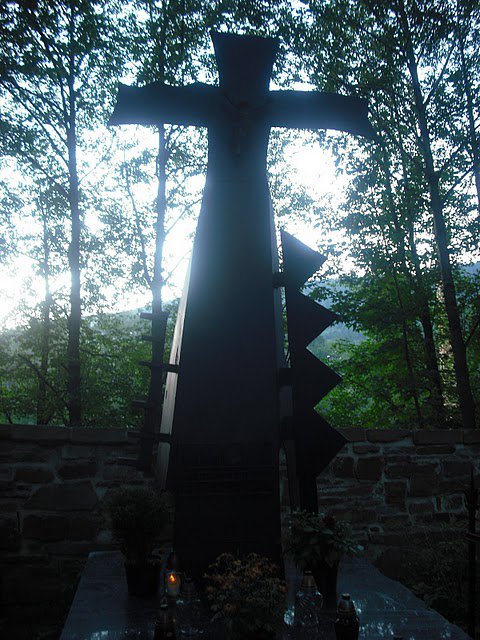
Hasior's grave in the old cemetery, Zakopane (designed by his students)
Subscribe to:
Comments (Atom)